VMQ (Silicone) O-rings
-60 °C to 200 °C
VMQ silicone O-rings have an extreme temperature range, excellent biocompatibility and flexibility at low temperatures. For food and medical use, compounds conforming to FDA 21 CFR 177.2600 are specified — silicone alone does not guarantee it; the specific compound decides.
Products
690 products
- In stock
O-ring 10.5×2 VMQ 70 Shore A
- Dimensions
- 10.5 × 2 mm · OD 14.5 mm
- Material
- VMQ · 70 ShA
SKU OR-VMQ70-10-5x2-MS
€0.17excl. VAT
- In stock
O-ring 10.6×2.3 VMQ 70 Shore A
- Dimensions
- 10.6 × 2.3 mm · OD 15.2 mm
- Material
- VMQ · 70 ShA
SKU OR-VMQ70-10-6x2-3-MS
€0.17excl. VAT
- In stock
O-ring 100×2 VMQ 70 Shore A
- Dimensions
- 100 × 2 mm · OD 104 mm
- Material
- VMQ · 70 ShA
SKU OR-VMQ70-100x2-RB60395
€0.67excl. VAT
- In stock
O-ring 100×3 VMQ 70 Shore A
- Dimensions
- 100 × 3 mm · OD 106 mm
- Material
- VMQ · 70 ShA
SKU OR-VMQ70-100x3-MS
€0.83excl. VAT
- In stock
O-ring 100×5 VMQ 70 Shore A
- Dimensions
- 100 × 5 mm · OD 110 mm
- Material
- VMQ · 70 ShA
SKU OR-VMQ70-100x5-RB60399
€1.42excl. VAT
- In stock
O-ring 102×3 VMQ 70 Shore A
- Dimensions
- 102 × 3 mm · OD 108 mm
- Material
- VMQ · 70 ShA
SKU OR-VMQ70-102x3-MS
€1.12excl. VAT
- In stock
O-ring 104.1×5.8 VMQ 70 Shore A
- Dimensions
- 104.1 × 5.8 mm · OD 115.7 mm
- Material
- VMQ · 70 ShA
SKU OR-VMQ70-104-1x5-8-MS
€1.44excl. VAT
- In stock
O-ring 104.5×3.5 VMQ 70 Shore A
- Dimensions
- 104.5 × 3.5 mm · OD 111.5 mm
- Material
- VMQ · 70 ShA
SKU OR-VMQ70-104-5x3-5-MS
€1.40excl. VAT
- In stock
O-ring 104×4.2 VMQ 70 Shore A
- Dimensions
- 104 × 4.2 mm · OD 112.4 mm
- Material
- VMQ · 70 ShA
SKU OR-VMQ70-104x4-2-MS
€2.94excl. VAT
- In stock
O-ring 105×3 VMQ 70 Shore A
- Dimensions
- 105 × 3 mm · OD 111 mm
- Material
- VMQ · 70 ShA
SKU OR-VMQ70-105x3-RB38466
€1.08excl. VAT
- In stock
O-ring 105×5 VMQ 70 Shore A
- Dimensions
- 105 × 5 mm · OD 115 mm
- Material
- VMQ · 70 ShA
SKU OR-VMQ70-105x5-RB38467
€1.39excl. VAT
- In stock
O-ring 107×2 VMQ 70 Shore A
- Dimensions
- 107 × 2 mm · OD 111 mm
- Material
- VMQ · 70 ShA
SKU OR-VMQ70-107x2-MS
€1.25excl. VAT
- In stock
O-ring 108.7×8.6 VMQ 70 Shore A
- Dimensions
- 108.7 × 8.6 mm · OD 125.9 mm
- Material
- VMQ · 70 ShA
SKU OR-VMQ70-108-7x8-6-MS
€3.70excl. VAT
- In stock
O-ring 108×3 VMQ 70 Shore A
- Dimensions
- 108 × 3 mm · OD 114 mm
- Material
- VMQ · 70 ShA
SKU OR-VMQ70-108x3-MS
€2.00excl. VAT
- In stock
O-ring 109.1×5.8 VMQ 70 Shore A
- Dimensions
- 109.1 × 5.8 mm · OD 120.7 mm
- Material
- VMQ · 70 ShA
SKU OR-VMQ70-109-1x5-8-MS
€1.82excl. VAT
- In stock
O-ring 10×1.5 VMQ 70 Shore A
- Dimensions
- 10 × 1.5 mm · OD 13 mm
- Material
- VMQ · 70 ShA
SKU OR-VMQ70-10x1-5-RB60047
€0.17excl. VAT
- In stock
O-ring 10×2.5 VMQ 70 Shore A
- Dimensions
- 10 × 2.5 mm · OD 15 mm
- Material
- VMQ · 70 ShA
SKU OR-VMQ70-10x2-5-RB60048
€0.18excl. VAT
- In stock
O-ring 10×2 VMQ 70 Shore A
- Dimensions
- 10 × 2 mm · OD 14 mm
- Material
- VMQ · 70 ShA
SKU OR-VMQ70-10x2-RB60361
€0.17excl. VAT
- In stock
O-ring 10×3 VMQ 70 Shore A
- Dimensions
- 10 × 3 mm · OD 16 mm
- Material
- VMQ · 70 ShA
SKU OR-VMQ70-10x3-RB60049
€0.17excl. VAT
- In stock
O-ring 11.6×2.3 VMQ 70 Shore A
- Dimensions
- 11.6 × 2.3 mm · OD 16.2 mm
- Material
- VMQ · 70 ShA
SKU OR-VMQ70-11-6x2-3-MS
€0.17excl. VAT
- In stock
O-ring 11.8×1.8 VMQ 70 Shore A
- Dimensions
- 11.8 × 1.8 mm · OD 15.4 mm
- Material
- VMQ · 70 ShA
SKU OR-VMQ70-11-8x1-8-MS
€0.06excl. VAT
- In stock
O-ring 11.8×2.4 VMQ 70 Shore A
- Dimensions
- 11.8 × 2.4 mm · OD 16.6 mm
- Material
- VMQ · 70 ShA
SKU OR-VMQ70-11-8x2-4-MS
€0.17excl. VAT
- In stock
O-ring 11.91×2.62 VMQ 70 Shore A
- Dimensions
- 11.91 × 2.62 mm · OD 17.15 mm
- Material
- VMQ · 70 ShA
SKU OR-VMQ70-11-91x2-62-MS
€0.17excl. VAT
- In stock
O-ring 110×3 VMQ 70 Shore A
- Dimensions
- 110 × 3 mm · OD 116 mm
- Material
- VMQ · 70 ShA
SKU OR-VMQ70-110x3-RB60355
€0.83excl. VAT
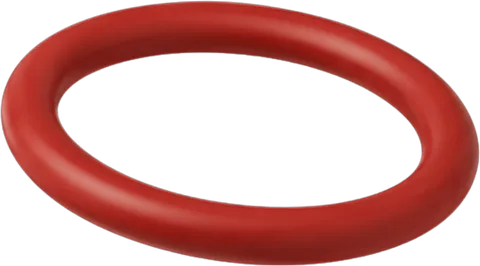
Temperature and chemical compatibility
Temperature and chemical compatibility
Temperature range: -60 °C to +200 °C (short-term up to +230 °C).
Featured products
Typical applications: food industry, medical and pharmaceutical, electrical-insulation seals, aviation at low temperatures, cosmetics.
VMQ (Silicone)
Each elastomer has different mechanical and chemical properties.
VMQ (Silicone) — properties and applications
VMQ (silicone) is the elastomer with the widest temperature range in the O-ring offering: it works reliably from −60 to +200 °C (briefly up to +230 °C) and its usual hardness is around 70 ShA. The material keeps its flexibility even at the extremes of this range, which makes it a sure choice where other materials already stiffen or soften. It's physiologically inert, with no taste or smell, and therefore suitable for food processing and medicine — food-safe compounds meet, for example, FDA 21 CFR 177.2600.
VMQ O-rings resist water, dry hot and cold air alike, ozone, UV and many polar media well, and they excel in electrical-insulation properties. It's precisely the exceptional temperature range and the physiological inertness that are the reasons silicone is deployed in food processing, medicine and anywhere hot or very cold air is at work. For contact with food, though, what's decisive is whether the specific compound carries the relevant certification — silicone on its own doesn't automatically guarantee it.
Watch the limits, though. VMQ isn't suitable for high-pressure steam (silicone hydrolyses), for permanent contact with mineral oils and fuels, or for dynamic or abrasive applications, because it has low mechanical strength and poor resistance to tearing and wear. On moving joints it therefore wears out quickly — there, choose FKM, and for oils at higher temperature, fluorosilicone (FVMQ), which combines silicone's temperature range with resistance to fuels.
Typical uses are found in food processing and medicine, in static seals across a wide temperature range, in electrical-insulation applications and anywhere hot air is at work. Compared with the other materials, VMQ's strong suit is its temperature range and inertness, and its weak point is mechanical resistance. Choose a silicone O-ring, then, when you need to handle extreme temperatures and contact with food in static joints — not for moving seals or permanent contact with oils.
Browse all O-rings across every material.
O-ring material comparison
Indicative values for a quick comparison. Temperature ranges are conservative (continuous service); for a specific medium always verify compatibility or consult a technician.
| Material | Temperature range | Mineral oil | Water | Acid | Fuel | Hardness (Sh A) | Relative price (vs NBR) |
|---|---|---|---|---|---|---|---|
| NBR | -30 – 100 °C | Excellent | Limited | Avoid | Excellent | 70 Sh A | 1.0× |
| HNBR | -30 – 150 °C | Excellent | Limited | Avoid | Excellent | 75 Sh A | 3.0× |
| FKM | -20 – 200 °C | Excellent | Limited | Excellent | Excellent | 75 Sh A | 5.0× |
| FFKM | -20 – 260 °C | Excellent | Excellent | Excellent | Excellent | 75 Sh A | 50.0× |
| EPDM | -40 – 130 °C | Unsafe | Excellent | Excellent | Unsafe | 70 Sh A | 1.2× |
| VMQ — your selection | -60 – 200 °C | Avoid | Excellent | Avoid | Avoid | 70 Sh A | 3.5× |
| PU | -40 – 80 °C | Excellent | Limited | Avoid | Limited | 90 Sh A | 2.0× |