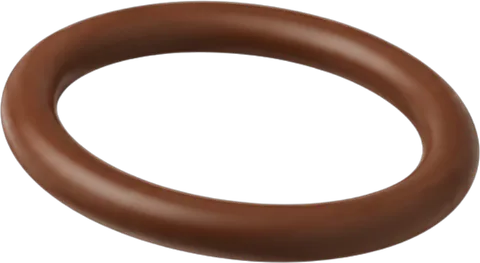
FKM (Fluoroelastomer / Viton®) O-rings
-20 °C to 200 °C
FKM (also known as Viton®) is a premium fluoroelastomer with excellent resistance to chemicals, high temperatures, fuels, and aggressive media. A standard in the chemical industry.
Products
1,477 products
- In stock
O-ring 11×1.8 FKM 70 Shore A
- Dimensions
- 11 × 1.8 mm · OD 14.6 mm
- Material
- FKM · 70 ShA
SKU OR-FKM70-11x1-8-MS
€0.17excl. VAT
- In stock
O-ring 18×3.5 FKM 70 Shore A
- Dimensions
- 18 × 3.5 mm · OD 25 mm
- Material
- FKM · 70 ShA
SKU OR-FKM70-18x3-5-MS
€0.35excl. VAT
- In stock
O-ring 21×1 FKM 70 Shore A
- Dimensions
- 21 × 1 mm · OD 23 mm
- Material
- FKM · 70 ShA
SKU OR-FKM70-21x1-MS
€0.26excl. VAT
- In stock
O-ring 26×1.5 FKM 70 Shore A
- Dimensions
- 26 × 1.5 mm · OD 29 mm
- Material
- FKM · 70 ShA
SKU OR-FKM70-26x1-5-MS
€0.30excl. VAT
- In stock
O-ring 32×3.5 FKM 70 Shore A
- Dimensions
- 32 × 3.5 mm · OD 39 mm
- Material
- FKM · 70 ShA
SKU OR-FKM70-32x3-5-MS
€0.33excl. VAT
- In stock
O-ring 50.16×5.33 FKM 70 Shore A
- Dimensions
- 50.16 × 5.33 mm · OD 60.82 mm
- Material
- FKM · 70 ShA
SKU OR-FKM70-50-16x5-33-MS
€2.11excl. VAT
- In stock
O-ring 74.5×3 FKM 70 Shore A
- Dimensions
- 74.5 × 3 mm · OD 80.5 mm
- Material
- FKM · 70 ShA
SKU OR-FKM70-74-5x3-MS
€1.78excl. VAT
- In stock
O-ring 75×3.5 FKM 70 Shore A
- Dimensions
- 75 × 3.5 mm · OD 82 mm
- Material
- FKM · 70 ShA
SKU OR-FKM70-75x3-5-MS
€1.98excl. VAT
- In stock
O-ring 76×3.5 FKM 70 Shore A
- Dimensions
- 76 × 3.5 mm · OD 83 mm
- Material
- FKM · 70 ShA
SKU OR-FKM70-76x3-5-MS
€2.10excl. VAT
- In stock
O-ring 7×2 FKM 70 Shore A
- Dimensions
- 7 × 2 mm · OD 11 mm
- Material
- FKM · 70 ShA
SKU OR-FKM70-7x2-MS
€0.17excl. VAT
- In stock
O-ring 9×1.8 FKM 70 Shore A
- Dimensions
- 9 × 1.8 mm · OD 12.6 mm
- Material
- FKM · 70 ShA
SKU OR-FKM70-9x1-8-MS
€0.17excl. VAT
- In stock
O-ring 3×2.5 FKM 70 Shore A
- Dimensions
- 3 × 2.5 mm · OD 8 mm
- Material
- FKM · 70 ShA
SKU OR-FKM70-3x2-5-MS
€0.22excl. VAT
- In stock
O-ring 37×3 FKM 75 Shore A
- Dimensions
- 37 × 3 mm · OD 43 mm
- Material
- FKM · 75 ShA
SKU OR-FKM75-37x3-MS
€1.25excl. VAT
- In stock
O-ring 10.78×2.62 FKM 80 Shore A
- Dimensions
- 10.78 × 2.62 mm · OD 16.02 mm
- Material
- FKM · 80 ShA
SKU OR-FKM80-10-78x2-62-RB56054
€0.17excl. VAT
- In stock
O-ring 10.82×1.78 FKM 80 Shore A
- Dimensions
- 10.82 × 1.78 mm · OD 14.38 mm
- Material
- FKM · 80 ShA
SKU OR-FKM80-10-82x1-78-RB56055
€0.25excl. VAT
- In stock
O-ring 100×5 FKM 80 Shore A
- Dimensions
- 100 × 5 mm · OD 110 mm
- Material
- FKM · 80 ShA
SKU OR-FKM80-100x5-RB56430
€3.33excl. VAT
- In stock
O-ring 101.27×2.62 FKM 80 Shore A
- Dimensions
- 101.27 × 2.62 mm · OD 106.51 mm
- Material
- FKM · 80 ShA
SKU OR-FKM80-101-27x2-62-RB56433
€1.65excl. VAT
- In stock
O-ring 107.67×1.78 FKM 80 Shore A
- Dimensions
- 107.67 × 1.78 mm · OD 111.23 mm
- Material
- FKM · 80 ShA
SKU OR-FKM80-107-67x1-78-MS
€1.67excl. VAT
- In stock
O-ring 10×1.5 FKM 80 Shore A
- Dimensions
- 10 × 1.5 mm · OD 13 mm
- Material
- FKM · 80 ShA
SKU OR-FKM80-10x1-5-RB56050
€0.27excl. VAT
- In stock
O-ring 10×2.5 FKM 80 Shore A
- Dimensions
- 10 × 2.5 mm · OD 15 mm
- Material
- FKM · 80 ShA
SKU OR-FKM80-10x2-5-RB56052
€0.33excl. VAT
- In stock
O-ring 10×2 FKM 80 Shore A
- Dimensions
- 10 × 2 mm · OD 14 mm
- Material
- FKM · 80 ShA
SKU OR-FKM80-10x2-RB56051
€0.19excl. VAT
- In stock
O-ring 10×3.5 FKM 80 Shore A
- Dimensions
- 10 × 3.5 mm · OD 17 mm
- Material
- FKM · 80 ShA
SKU OR-FKM80-10x3-5-RB56616
€0.50excl. VAT
- In stock
O-ring 10×3 FKM 80 Shore A
- Dimensions
- 10 × 3 mm · OD 16 mm
- Material
- FKM · 80 ShA
SKU OR-FKM80-10x3-RB56053
€0.37excl. VAT
- In stock
O-ring 10×5 FKM 80 Shore A
- Dimensions
- 10 × 5 mm · OD 20 mm
- Material
- FKM · 80 ShA
SKU OR-FKM80-10x5-MS
€0.88excl. VAT
Temperature and chemical compatibility
Temperature and chemical compatibility
Temperature range: -20 °C to +200 °C (short-term up to +230 °C).
Featured products
Typical applications: chemical industry, oil and gas, engine seals, fuel systems, aviation, semiconductors.
FKM (Fluoroelastomer / Viton®)
Each elastomer has different mechanical and chemical properties.
FKM (Fluoroelastomer / Viton®) — properties and applications
FKM (Viton®, fluoroelastomer) is a premium sealing material for high temperatures and aggressive media. FKM O-rings handle temperatures from −20 to +200 °C (briefly up to +230 °C) and are typically supplied at a hardness of 75 ShA, which makes them a reliable choice wherever ordinary rubbers already fail. The material's character is clear-cut: performance under thermal and chemical load, not the lowest price. Viton® is simply a brand name for FKM — technically it's the same family of fluoroelastomers.
Chemically, FKM has excellent resistance to mineral oils, fuels, many acids, hydrocarbons and solvents, and it copes well with ester oils too. It also excels in resistance to ozone, UV and weathering, so it handles the outdoor environment as well. Thanks to this combination of thermal and chemical resistance, FKM is the standard in the chemical industry, in engines and in fuel systems, but also in aerospace and semiconductor applications — wherever a seal has to resist heat and the medium at the same time. It also has very low gas permeability, which you'll appreciate in vacuum and gas technology. If you've ever weighed up Viton vs NBR, this is the trade-off: FKM buys you heat and chemical resistance that NBR can't reach, at a higher price.
Watch the limits, though. An FKM O-ring isn't suitable for steam and hot water, for strong bases and amines (for those, reach for FEPM/Aflas), for glycol-based brake fluids, or below −20 °C, where the standard compound stiffens. These limitations have to be respected — this is exactly where the service life of the seal is decided. For low temperatures there are special low-temperature FKM compounds, which you can ask about.
Compared with the other materials, FKM stands above both NBR and HNBR in performance, but at a higher price; below it is EPDM (cheaper, but only for water, steam and brake fluids) and above it is FFKM (almost universal chemical resistance at an order-of-magnitude higher price). If temperature or chemical resistance is decisive for your application — and you don't need the extreme that calls for FFKM — an FKM O-ring is the right, proven choice.
Browse all O-rings across every material.
O-ring material comparison
Indicative values for a quick comparison. Temperature ranges are conservative (continuous service); for a specific medium always verify compatibility or consult a technician.
| Material | Temperature range | Mineral oil | Water | Acid | Fuel | Hardness (Sh A) | Relative price (vs NBR) |
|---|---|---|---|---|---|---|---|
| NBR | -30 – 100 °C | Excellent | Limited | Avoid | Excellent | 70 Sh A | 1.0× |
| HNBR | -30 – 150 °C | Excellent | Limited | Avoid | Excellent | 75 Sh A | 3.0× |
| FKM — your selection | -20 – 200 °C | Excellent | Limited | Excellent | Excellent | 75 Sh A | 5.0× |
| FFKM | -20 – 260 °C | Excellent | Excellent | Excellent | Excellent | 75 Sh A | 50.0× |
| EPDM | -40 – 130 °C | Unsafe | Excellent | Excellent | Unsafe | 70 Sh A | 1.2× |
| VMQ | -60 – 200 °C | Avoid | Excellent | Avoid | Avoid | 70 Sh A | 3.5× |
| PU | -40 – 80 °C | Excellent | Limited | Avoid | Limited | 90 Sh A | 2.0× |